|
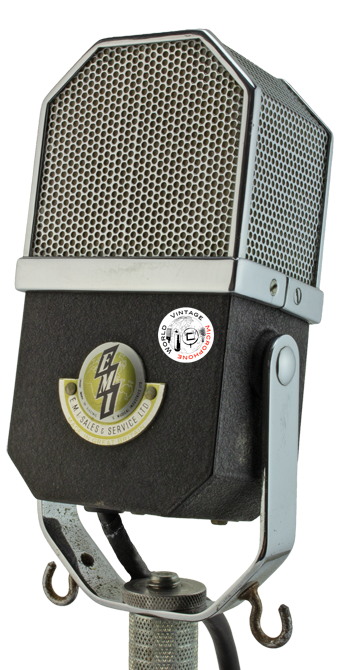
The microphone of this month is a classic English ribbon type, which has become a sought after treasure. Like most ribbon microphones, it has a bidirectional pickup pattern, its output is rather low, because of the 20 Ohm transformer, which was perfect for older equipment. To suit today's gear, either a step up transformer is necessary, or a swap of the original transformer for one that provides 300- 600 Ohms.
EMI is of course closely associated with the famous Abbey Road studios, and although vintage EMI ribbon mics are part of their collection, this model was never used there.
Instead, the PM 245 was designed to accompany a 'portable' disc recorder, with an astonishing weight of 60 Kg!
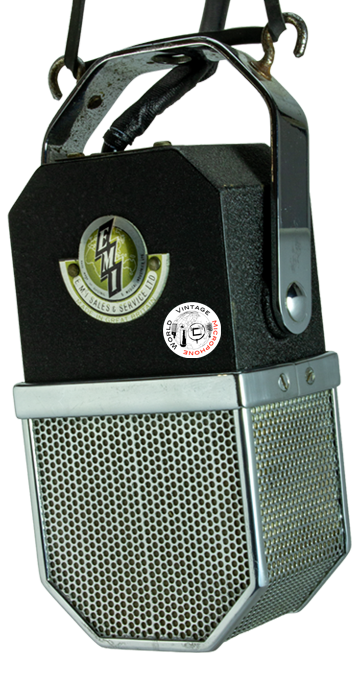
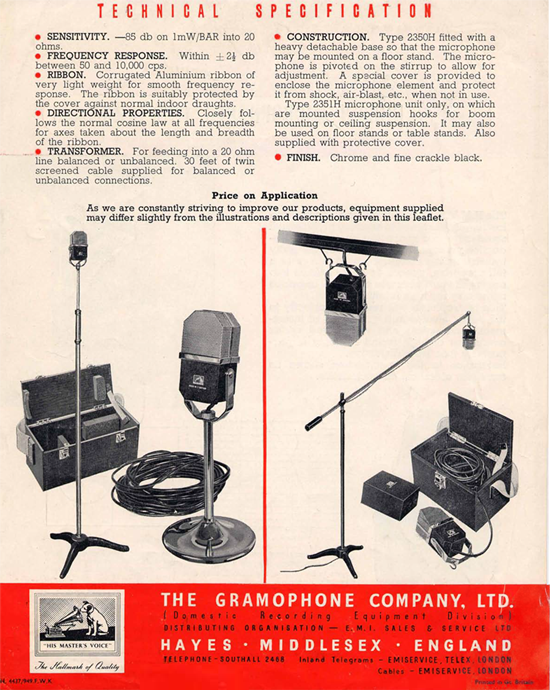
The set brought out in 1945, as HMV 2300 disk recorder and HMV ribbon microphone. The microphones came in two versions: HMV 2350, for stand use, or HMV 2351, with hooks that enabled boom use, but it could also be used on a stand.
The system was meant for record shops and small business owners, to record demo's or 'audio greetings'. It seems the young Beatles were one of the bands that recorded a demo with such a set. They were also meant for home use, to record music, radio programs, or spoken word.
In 1950, it was decided to offer the microphone also without the recorder, for PA use. Originally both the microphones and recorders were badged as HMV (His Masters Voice), somewhere in the mid-fifties this was changed into EMI, the microphones were the same.
The professional EMI ribbon microphones, which stil reside at Abbey Road, were designed by Alan Blumlein, the audowizard, who also invented stereo disc recording in a single groove, in 1931! Alas, he died much too soon, while working on the development of radar, in the Second World War.
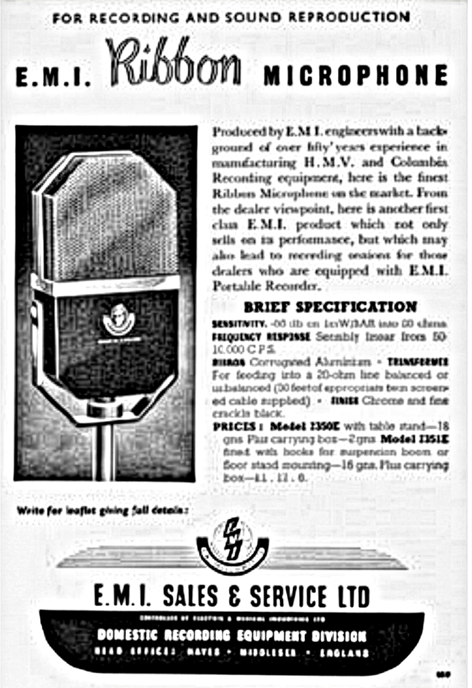
It is not unlikely that the design of the PM 245 is derived from those professional ribbon mics, that have a reputation for delivering a super silky sound. It was advertised as 'Produced by EMI engineers with a background of over 50 years of experience in manufacturing HMV and Columbia recording equipment' and 'The finest Ribbon Microphone on the market'. The build of the PM 245 is very good, proving the quality of the British as superb toolmakers. Even the chrome has withstood the years.
To protect the microphones, they came with a close fitting cover, which had a screen on top, to avoid air presure build-up when the microphone was inserted into it. In turn the covered PM 245 was stored in a wooden transport box.
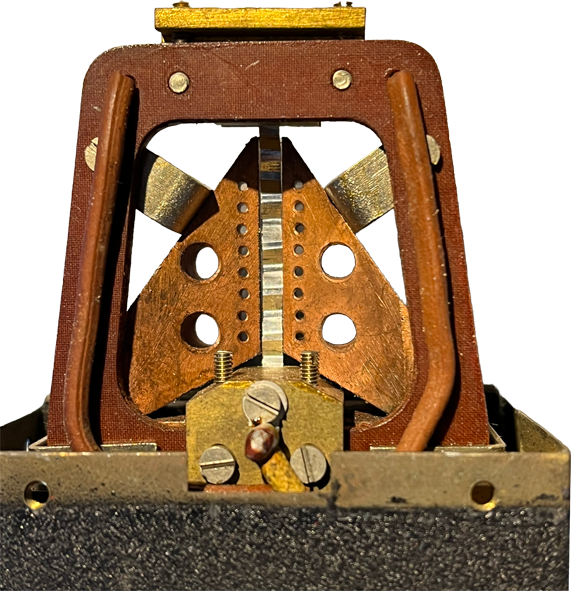
These microphones have found their way to recording studios and although their sound is often pretty dark, even for a ribbon microphone, whith a fresh ribbon, and modern transformer, they deliver good audio.
These and many more types feature in my book Witnesses of Words. More information about that can be found at www.witnessesofwords.com

|
|
|
|
|
Top: The stylish shape of the EMI PM 245
Below: Sound, Ribbon motor and EMI & HMV ad |
|
|
|
|
|




 Video's
 Contact